The Decision Room: Strategic AI for the Mid-Market Leader
Your business will have an AI architecture.
The only question is whether leadership designs it or inherits it.
A private, on-demand executive decision program. Two seats. One instrument. It ends with the ten decisions made.
Not a tool course. Not a vendor demonstration. Not an IT project. Ten decisions that determine whether AI becomes your competitive advantage or your most expensive line item. Every one of them belongs to the chair at the top.
ENTER THE DECISION ROOM: $500, TWO SEATS →
One purchase. Lifetime access. Immediate entry: you enter when you decide to.
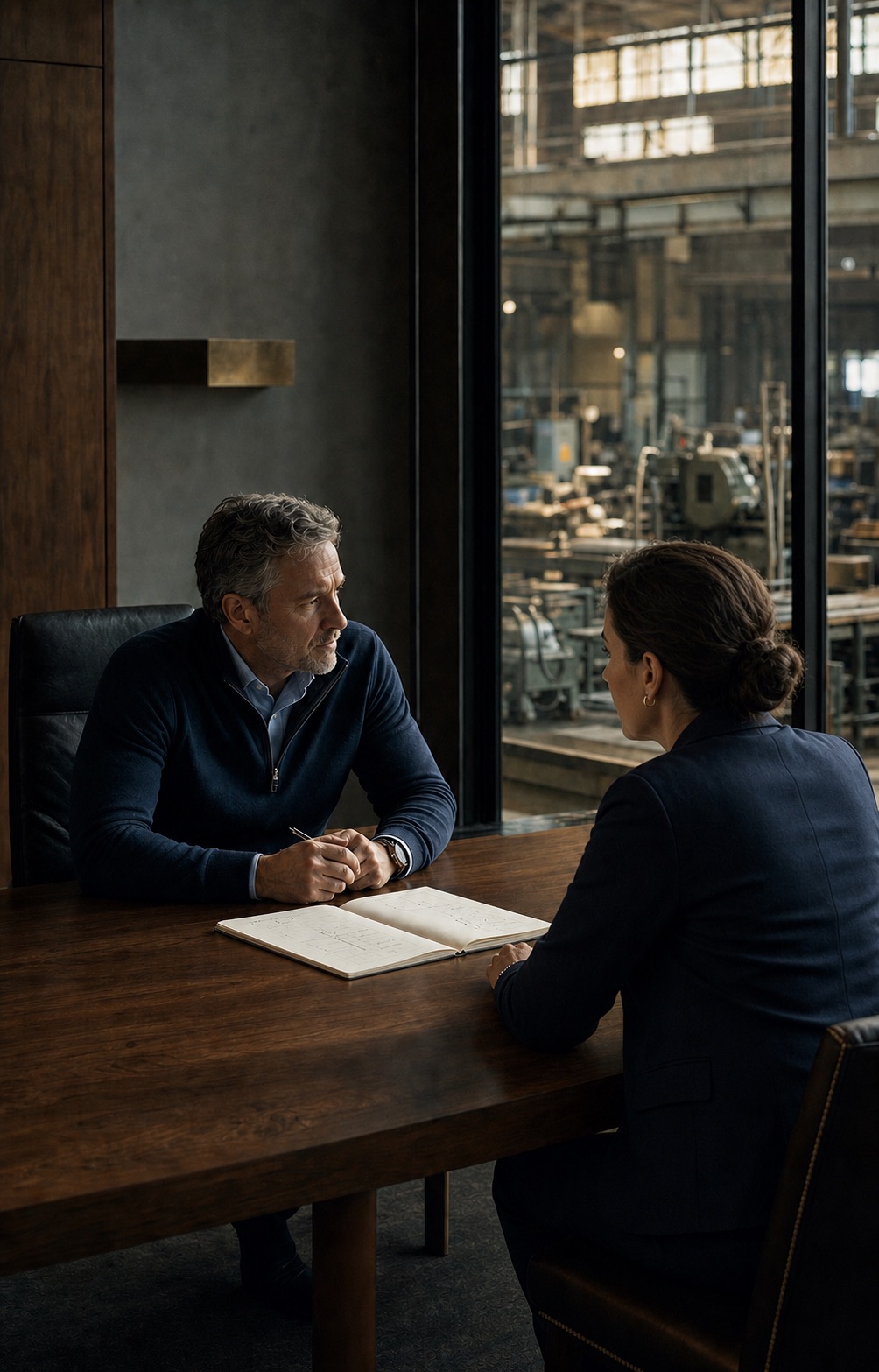
This is not a webinar. It is a room, and the door is closed.
Kodak invented the digital camera. Not missed it. Invented it. The patents, the prototypes, a head start measured in decades. The technology was never the problem. What Kodak could not build was the one thing no technology can hand you: the leadership decisions to question the economics of its own past. So the future sat in a drawer. Film paid the bills. And nobody ever opened the drawer, because opening it was a decision, and the decision belonged to a chair nobody was sitting in.
That failure happens at a specific altitude. At the top of the Strategic AI Intelligence Architecture™, above everything the vendors want to sell you, sits the decision layer: the place where a business decides what AI is going to become before a single dollar ever reaches a vendor. In most mid-market businesses, that layer sits empty. Not because the leader was not paying attention. Because the AI market sells from the bottom up: tools first, pilots first, vendors first. A subscription gets bought, a chatbot gets turned on, and the business tells itself it is "doing AI" while the decisions that decide whether any of it matters sit unmade at the top.
In a mid-market manufacturing business, AI does not land on empty ground. It lands in a business already carrying decades of equipment decisions, spreadsheet dependencies, tribal knowledge walking the floor in a handful of veterans, disconnected systems, customer commitments, quality requirements, and processes nobody would design the same way today. That is why the first AI decision is never which tool to buy. It is what kind of operating architecture you are building.
You already run this discipline. On your floor, quality is built in, not inspected in at the end. You calibrate before the run rather than sorting defects at the dock. You would send back an uninspected part from a supplier without a second thought, and everyone in the building knows it. That standard is a reason the business is still standing. It has never once been applied to an AI decision made under your roof. You are doing this all the time. You are not doing it with AI.
The forecast that is about you
Gartner forecasts that over 40% of agentic AI projects will be canceled by the end of 2027. Read the causes: unclear business value, inadequate risk controls, escalating costs. Every cause on that list begins as a leadership decision before it becomes a technology failure. That is not a technology forecast. It is a leadership forecast wearing a technology headline.
And here is the part nobody says out loud: the research behind that forecast was never written for you. Enterprise AI guidance assumes an enterprise bench: a CIO with a data office behind him, a transformation team, a governance committee, outside advisers, and a budget built to absorb failed experiments. The intelligence that decides who survives this transition runs $25K–$60K a year in subscription fees, and it is addressed to that bench. You do not run a business with all of that behind you. And you should not have to pretend you do.
The Decision Room takes that whole strategic weight and turns it into ten decisions a mid-market leadership team can make at the top of its own business. Without the bureaucracy. Without the bench. In the room, with the person you brought.
The decisions are already being made
Decisions are already being made in your business. Your people are using public AI models. Departments are testing vendors. The software you already own is inserting AI into your operation whether you asked for it or not. Data is moving. Expectations are forming. The absence of a leadership decision is not a prudent pause. It is permission for the architecture to assemble itself.
Ten decisions. One chair.
Inside the room: ten decisions. Not ten tools. Not ten vendors. Ten decisions, and every one belongs to the person at the top. They cannot be delegated to IT. They cannot be outsourced to an agency. And nobody selling you software will ever put them in front of you, because every one of them gets decided before the software conversation starts.
Each decision is named. And each is priced: what it touches in your operation, what every month of delay quietly costs, what premature spending wastes, and what opens up once the decision is made. Not estimated in the abstract. Priced against your own numbers, in the room.
The territory they cover: where AI belongs in your business, and where it does not. What must be true in your operation before anything deploys, so scattered experiments never harden into your next generation of technical debt. Who owns each decision, in what order they get made, and how you will judge the difference between advantage and expense. And how the business keeps what it learns, so no department, plant, or vendor ever starts over from zero.
Inside that territory sit ten named decisions. What the ten are stays behind the door. That is the product.
Each closes on the same contrast: what takes an enterprise a committee and a full budget cycle takes you one conversation at the top of your own business. Your size is not the thing you survive in this transition. It is the weapon.
What you leave with
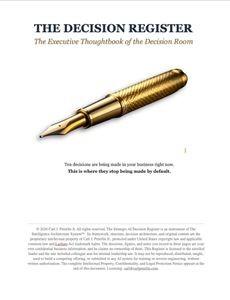
The Decision Register. Your permanent record of the ten decisions: the call you made, the dollars behind it, who owns it, and what happens next. It is built to leave the room with you: into your leadership meetings, your budget cycle, your next vendor conversation. The room manufactures decisions. The Register is where yours get recorded, in your own handwriting, and it goes home with you.
You do not leave with notes. You leave with a defined position on every one of the ten decisions, a sequence for what happens first, a short list of what can never be delegated, and a shared language with the leader in the second seat. The business you walk back into is the same. The chair is not.
The second seat
Bring the person you would tell at the kitchen table. Your president, your COO, your CFO, your successor, your co-owner. The second seat is not a discount. It is there because a decision becomes real when another leader can challenge it, witness it, and carry it into the business with you. You will want a witness for this one.
Who the room is built for
Built for
The Decision Room is built for the leadership of a mid-market manufacturing business that knows AI matters and refuses to chase disconnected tools.
- That has experiments running somewhere in the building right now with no governing architecture over them.
- That needs to know where AI will actually move margin, throughput, and resilience, and where it will only move budget.
- That cannot justify an enterprise transformation office and should not want one.
- And that understands waiting is also a decision: it is the decision to inherit.
Not built for
It is not built for the leader who would rather not know the number. The room prices your decisions against your own operation. If you do not want to see those numbers, do not enter.
It is also not built for leaders shopping for:
- A software demonstration
- A catalogue of tools
- A folder of prompts
- A project to hand down to IT
Who is in the room with you
Carl J. Peterlin Jr. has spent 42 years inside business and technology transformations: pharmaceuticals, defense, energy, and high-growth startups. Four technology transitions crossed from the inside. Internet. Mobile. Cloud. Now AI. Each one showed up wearing new clothes and asked the same question underneath: how does a business redesign its decisions, and the architecture that runs them, before the new technology sets the old assumptions in concrete? He documented the one pattern that decides which businesses survive the crossing, and named the discipline: Strategic AI Intelligence Architecture™. He is the only Strategic AI Intelligence Architect™ practicing in it. He wrote Death To Excel! and Your SMB AI Revenue Ratchet along the way.
In his words: "Everybody's selling AI tools. That's tactics. I work with you on the strategy and the architecture that runs it, so AI becomes your competitive advantage instead of an expense. And I can tell you, in dollars, what every month you wait is costing you."
Why this room exists:
nobody builds for your chair. The enterprise firms sell transformations you cannot justify and should not want. The research industry writes for a bench you do not carry. And the local market will sell you a chatbot and call it a strategy. The Decision Room exists because the ten decisions that determine your outcome were going unmade. Not for lack of leadership. For lack of a room built for the leader who has to make them.
Asked before entering
"We're already running pilots." Then you are the reader this was built for. Pilots without a governing architecture are how accidental architecture assembles: each one makes local sense, and together they harden into the system nobody chose. The room does not stop your pilots. It puts a chair above them.
"Our data isn't ready." The room is not a deployment. It is the set of decisions that determine what "ready" even means for your operation, and in what order readiness gets built. Waiting for readiness before making the decisions is the sequence exactly backwards.
"We already have an IT provider." Keep them. Not one of the ten decisions can be made by a provider, and your provider would tell you the same. They execute what leadership decides. The room is where the deciding happens.
"Is it technical?" No. If a decision required a technical background, it would belong to IT, and then it would not be in the room. All ten belong to the chair.
"Who should take the second seat?" The person whose judgment changes the decision: president, COO, CFO, successor, co-owner. The seat is assignable after purchase, so you can enter first and choose your witness once you see what the room asks.
"How is this different from the Diagnostic?" The Decision Room is the ten decisions, on demand, at your own pace, with your own numbers. The Strategic AI Intelligence Diagnostic™ is a $750 working session where those decisions get pressed against your operation with the architect in the room. The Room is where you decide. The Diagnostic is where your decisions meet 42 years of pattern recognition.
"Does it recommend vendors or tools?" No. That is the point. Every tool conversation you have after the room will go differently, because you will be the one holding the architecture.
"Can we expense it?" It is executive development for two leaders, purchased once. Ask your CPA; the conversation will be short.
The room
The Decision Room A private, on-demand executive decision program.
- The ten decisions, each named, each priced against your own operation
- Two executive seats: yours, and the one you assign
- The Decision Register, yours permanently
- Lifetime access: return whenever a new vendor, investment, or deployment forces a decision back onto the table
- Immediate entry upon purchase
- $500, one time
ENTER THE DECISION ROOM: $500, TWO SEATS →
One purchase. Lifetime access. Immediate entry: you enter when you decide to.
The Decision Room is complete on its own. It does not end in a disguised sales presentation. It ends with an assignment, and with one door named and priced in advance, so you know exactly what stands on the other side before you ever enter: the Strategic AI Intelligence Diagnostic™, a $750 working session for leaders who want the ten decisions pressed against their own operation with the architect in the room. That is the whole funnel. It is printed here so you never have to wonder what is waiting at the end.
Kodak had the patents, the people, and thirty years of warning. What it never had was a room where the decisions got made.
Yours is open.