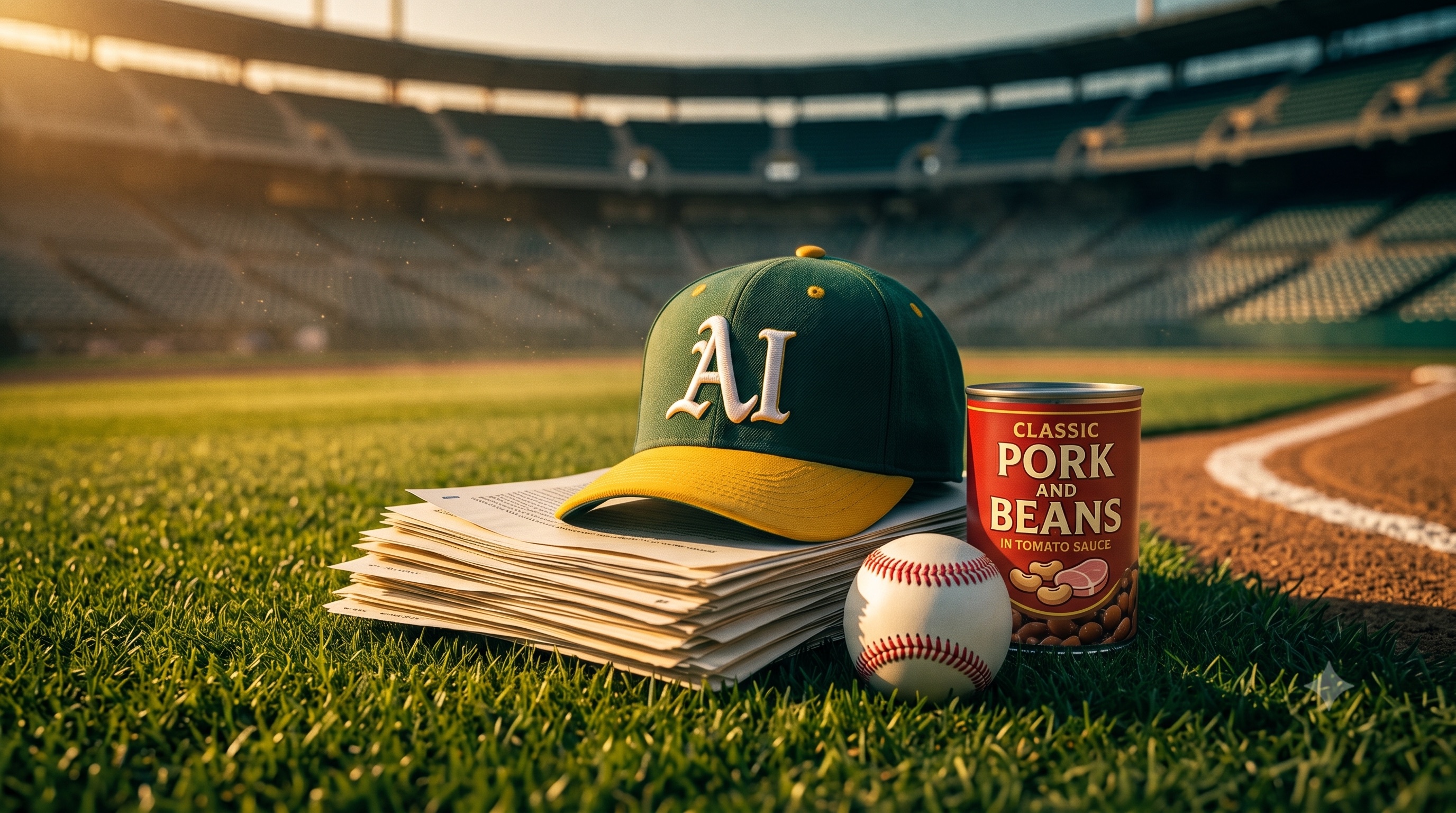
A mentor handed me the Moneyball book two decades ago, back when the ink was barely dry (thank you, Carl Janssens), and I read it the way everyone read it then: as a sharp business story wearing a baseball cap. This week I noticed the 2011 film sitting on Netflix, and I watched it with 2026 eyes.
I enjoyed every minute. And I realized I had watched the wrong movie the first time. The first time, it was a baseball story. This time, it was a documentary about the decision sitting on your desk right now.
Let me show you what 2026 eyes see.
The game was rigged, and everyone had agreed to pretend it wasn't.
The film opens on two numbers: New York's payroll, north of $114 million, and Oakland's, at roughly $40 million. Billy Beane could not buy what the Yankees bought. Every general manager in his position responded the same way: work harder at the old game, lose politely, blame the economics.
Beane refused the premise instead. He stopped asking "how do we compete with their budget" and started asking "what game can we win that they don't know they're playing."
If you run a $20M–$100M manufacturer, you know this opening scene personally. The Fortune 500 is spending on AI at a scale you cannot match and never will. The question 2026 eyes ask: are you funding the game you can win, or the one you inherited?
The data was already there. It arrived looking like nothing.
Here is the detail that should keep you up tonight. In 1977, a night security guard at a pork-and-beans cannery photocopied 68 pages of his own baseball analysis and sold them through a classified ad for $3.50 a copy. About 75 people bought one. The knowledge inside would eventually dismantle a century of scouting dogma, and the sport's response was to grade the package instead of the intelligence. A photocopied stack. A want ad. A night watchman. Ridiculous. For a quarter century, an entire industry laughed at the wrapper while the gold sat in plain sight. Price of admission: $3.50.
Twenty-five years later, the intelligence baseball revealed to the night guard at a bean cannery won 103 games for a man named Beane. The record does not usually sign its work that clearly. The Yankee roster it embarrassed cost $114 million. The intelligence that broke their 55-year-old record cost $3.50.
Your business is emitting that same intelligence right now. Every quote, every changeover, every late shipment, every service call is writing it down somewhere. So the question is no longer whether your numbers exist. They do. The question is what package you require the gold to arrive in before you'll read it, and who in your business is reading it now. The honest answer, in most mid-market operations, is a name you cannot produce.
It was never the computer.
This is the part the casual viewing misses and the 2026 viewing cannot. Paul DePodesta's laptop was not the advantage. Any front office in baseball could buy the identical machine that afternoon. Twenty-nine of them didn't lose because they lacked the tool. They lost because they lacked the architecture: the decisions about what to measure, what to stop paying for, and what the unit of purchase actually was. Beane's reframe was brutal in its clarity. Teams were buying players. He was buying runs.
Watch the boardrooms of 2026 run the same error in reverse. A business signs an AI subscription, stands up a chatbot, and tells itself it is doing AI. That is the scouting room telling itself it understands the game because it owns a computer. The tool was never the thing. It never is. The 42-year pattern proves it across four technology transitions: the businesses that deploy before they architect pay for the same capability twice and own it never.
The season was decided in a room, before a single pitch.
The 2002 A's won 103 games and ran off twenty straight. Not one of those wins was created on the field. They were created earlier, in a front office, in a short and specific set of decisions: which measures govern, which spending stops, what a win actually costs. The games were the receipts. The room was the product.
There is a version of that room for AI. It is not a technology room. It holds a short, specific list of decisions that get made before any tool is purchased, and every mid-market leader is currently making those decisions one way or the other: deliberately, in the room, or by default, at the vendor's kitchen table. The Catch-Up Penalty is what the second group pays.
The window closed. It always closes.
The ending 2026 eyes cannot look away from: Boston hired Bill James, adopted the architecture, and buried an 86-year curse within two seasons. They also offered Beane the richest GM contract in the sport's history, because they understood that the architecture was worth more than any player it evaluated. And Oakland's edge? It decayed the moment the league caught up. The advantage was never permanent. It belonged to whoever moved while the scouts, and the conventional wisdom they were paid to defend, were still laughing.
The scouts in your industry are still laughing. That is the window.