EDITION 14 | August 25, 2026
YOUR BUILDING IS ALREADY TALKING.
YOU ARE NOT LISTENING.
Last week I wrote about Deming's law: quality cannot be inspected into a product. It must be built in.
The responses came back saying the same thing Edition 13 always gets: I already knew that. I just did not know I knew it about AI.
Which means you already know what I am about to say about data.
Every operation you run produces intelligence as a natural byproduct of running it.
Not the intelligence your IT team is trying to build. Not the dashboard your software vendor is trying to sell you. The raw, continuous, unfiltered signal that your building gives off every single day — every machine cycle, every scheduling decision, every quality flag, every customer interaction, every shipment variance, every time a veteran on your floor makes a call that the system never records.
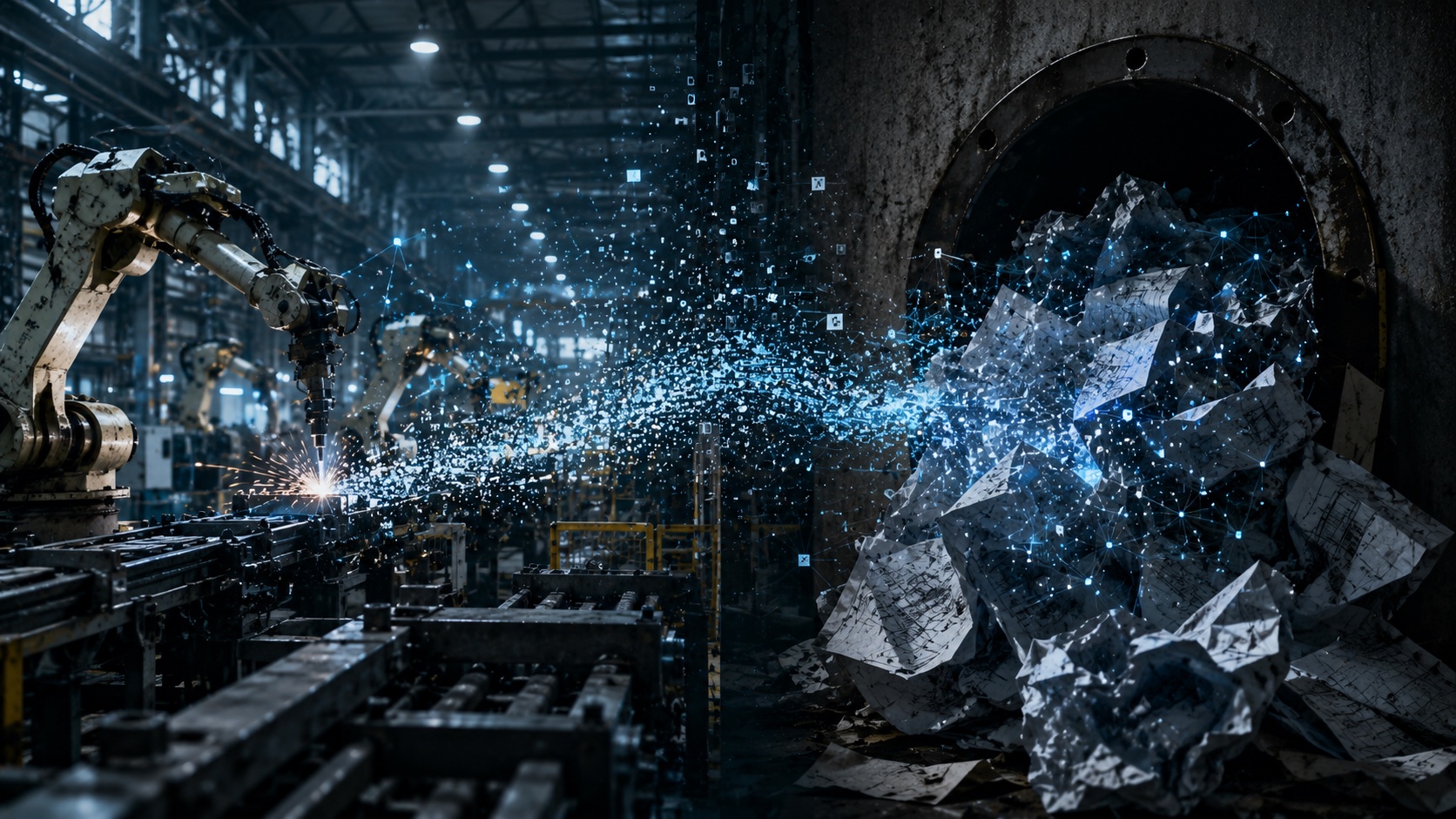
I call it Digital Exhaust.
The word is deliberate. Not because it is waste — it is not. Because every productive process gives it off. A tree exhales oxygen. That exhaust is not a byproduct to manage away. It is what living processes naturally produce. Your operation exhales data the same way. Continuously. Involuntarily. Whether you capture it or not.
Here is what most $20M–$100M manufacturers are doing with theirs: nothing. It vents into the atmosphere. It disappears into disconnected software. It walks out the door in the head of a veteran who retires on a Friday and takes thirty years of pattern recognition with him. It is not lost because anyone decided to lose it. It is lost because no architecture was built to capture it.
That is not a data problem. It is an architectural decision — made by default.
The Raw Material Was Already There
You have been generating Digital Exhaust for years. Every interaction your operation touches produces it. Every process you run gives it off. The raw material for an intelligence system that compounds every week already exists inside your building. It has been there since the day you opened.
The question is not whether you have it. You do. The question is whether it is being captured or venting.
Right now, for most manufacturers reading this, it is venting.
The Compounding Mechanism
The manufacturers who are building Unassailable Moats are not building them from better tools. They are building them from captured exhaust.
Here is the mechanism. When Digital Exhaust is captured into a connected intelligence system, it does not flow in one direction. It radiates outward and feeds every part of the operation simultaneously. Your scheduling data makes your maintenance predictions sharper. Your maintenance history makes your quality controls more precise. Your quality signals make your customer delivery commitments more accurate. Your customer patterns feed back into your scheduling. Every output sharpens every other.
This is not a pipeline. It is a matrix. And what a matrix does, a pipeline cannot: it makes yesterday's decisions better-informed today. Every new signal does not just point forward — it also improves the value of every signal that came before it.
That is the compounding mechanism. The organization that has been capturing exhaust for twelve months does not have a twelve-month advantage over the one that starts today. It has a permanently deeper data position that every future decision draws from. The late-mover is not twelve months behind. The late-mover is making every subsequent decision from a data position they have not yet reached.
The gap is architectural, not mundane. And it widens while you read this.
What Deming Said Next
Deming said it first about quality: the standard is not the inspector at the end of the line. The standard is the system that builds it right from the beginning.
He said something else in 1982 that most manufacturers heard but did not fully absorb. Point One of his fourteen points. The aim is not to stay the same. The aim is to become competitive. To provide jobs. To build a business that can do those things tomorrow, not just report that it did them yesterday.
Become. That is a growth verb. It is not a maintenance verb. You cannot become competitive by inspecting at the end of the line. You cannot become competitive by venting your intelligence into the atmosphere.
The manufacturers who became the standard on quality did so by building the system before the shipping dock demanded it. The manufacturers who will become the standard on AI will do so by building the intelligence architecture before the market prices them out of it.
The exhaust is already there. The building is already talking. The question is whether anyone is listening — and whether what they hear is being captured, connected, and put to work.
The One Question That Tells You Where You Stand
What does your Digital Exhaust currently feed?
Not what could it feed. What does it actually feed, today, in your operation?
If the honest answer is “nothing connected” — you have identified the gap. Not a technology gap. An architectural one. And an architectural gap has an architectural answer.
The Strategic AI Intelligence Diagnostic™ is where that answer starts. It examines exactly this: where your Digital Exhaust is currently going, what the gap is costing you at your revenue level, and what a 90-day sequence looks like to close it. The conversation starts at [email protected].
If you want to make the architectural decisions before that conversation, The Decision Room: Strategic AI for the Mid-Market Leader is where that work begins. $500. Two seats — one for you, one for the person you would tell at the kitchen table. carlpeterlin.com/decision-room.
Carl J. Peterlin Jr. is the Strategic AI Intelligence Architect™ serving $20M–$100M B2B manufacturers. The Intelligence Architecture System™ is the productized delivery path from first architectural decision to Unassailable Moat.
EDITION 14 | THE FOURTH INTELLIGENCE | carlpeterlin.com