Last edition ended with your Built Intelligence walking out two doors, and a promise that we would start building.
So here is the first thing to build. It is not AI.
The leaders who will get a return from AI this decade are deciding, right now, what their AI will read. The ones who will get nothing are deciding which tool to announce. The difference shows up on your income statement, and it shows up fast.
I watched that difference play out on a government project.
The people running it were certain AI would fix their problem. The analysis said otherwise. The problem lived in the database: how the records were structured, where they contradicted each other, which fields nobody trusted. Restructuring it was the proper fix. It was faster. It was cheaper.
They rejected it. It did not use AI, and AI was what they had promised. So, for the optics, they bolted AI onto the same broken records. Their return today is close to zero.
Nobody on that project was foolish. They were answering the question in front of them: what are we doing with AI? They never answered the question underneath it: what is our AI going to read?
You do not run a government agency. You do not answer to a press office. But you have heard the question.
A customer's supplier survey asks what you are doing with AI. Your banker asks over lunch. A competitor posts a video of a chatbot quoting jobs. Every one of those questions pulls you toward the same answer: buy something you can point to.
Now picture the other answer.
Your inside salesperson opens one system to build the quote due by noon. It already knows the price you held with this customer last spring, the margin floor on that alloy, and the job that went sideways in March and why. Your production manager asks the same system whether second shift can absorb a rush order, and it answers from today's schedule, not last month's spreadsheet. Your controller drafts the board summary from numbers that match the ones the floor sees. Three people, three questions, one set of facts. Nobody pasted your price sheet into a stranger's browser to get there.
That is not a smarter tool. It is a business that knows what it knows, in one place, and lets every tool read from it.
I call it the Governed AI Data Fabric™: one source of truth your business owns, running from the plant floor through every customer you serve to the decisions leadership makes, under rules leadership sets. Every AI tool your people use reads from it and writes back to it. Every good answer stays.
What it keeps is your Built Intelligence: everything your business knows that no competitor does. How you price a job. How you make the part right the first time. Who buys, why, and what keeps them coming back. You paid for it in salaries, scrap, and bids you lost while you were learning. It is not something your business has. It is your business. Inside the Fabric it stops leaking and starts compounding.
A competitor can buy every tool you buy. He cannot buy what your Fabric has learned. That is the Unassailable Moat, built as a literal thing you own.
You can subscribe to intelligence, or you can architect it. The subscription ends. The architecture compounds.
Go back to that government project, because the uncomfortable part is not what you would expect.
The AI was never the problem. It did exactly what it was built to do. It read what it was given, and what it was given was broken. A model that reads contradictory records does not resolve the contradiction. It repeats it, faster and with more confidence than the person who used to catch it.
The most expensive thing you can do is automate a mistake.
So the first thing you build is the part nobody photographs. I call it Ground Truth: the verified record of what actually happens on your floor and in your back office. Which jobs ran, what they cost, what shipped, what came back. Get that right and every tool you add later earns its keep. Get it wrong and every tool you add later is chaos at the speed of AI.
That is the order. Ground Truth first. The Fabric around it. Then the AI, chosen for the decisions it will serve, reading records you trust. Most leaders start at the last step and spend years paying for the ones they skipped.
You already know this. You learned it the expensive way, long before anyone said "AI" in your building.
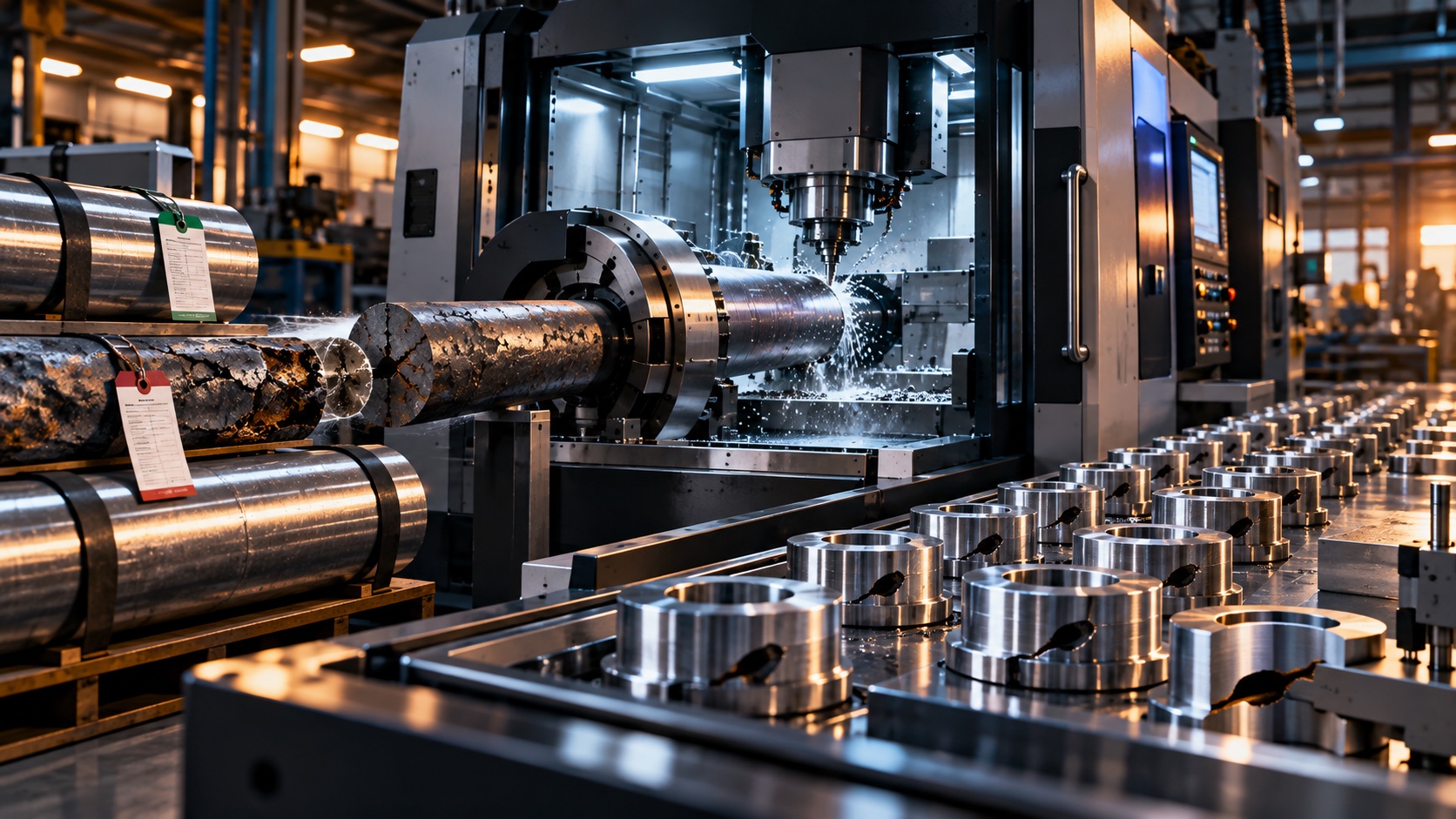
Every leader who built a manufacturing business learned that a machine is only as good as what you feed it. You did not get here by buying the newest spindle and running whatever stock showed up on the dock. You got here by refusing to run a job on material you could not trust. That refusal is a large part of why your customers call you instead of the shop down the road.
You verify the cert on every heat lot that comes through your door. You are not doing it with AI.
Nobody in your building would load unverified bar stock into your newest machine because the machine was new and a customer asked about it. That is exactly what the government project did with its data. It is what most businesses are about to do with theirs, one announced pilot at a time.
AI does not fix a mess. It ships it.
The faster, cheaper fix lost on that project because it was invisible. Nobody announces a database restructuring. Nobody posts a video of records that finally agree with each other.
But the invisible work is the only part that pays. The visible part is what you get to announce afterward, when it works.
AI is the last thing you build. Build it last, and it is the first thing that pays.
If you lead a manufacturer in Northeastern Pennsylvania, I am exhibiting at the NEPIRC AI Summit in Wilkes-Barre on October 29, and I cordially invite you to attend. It is free for manufacturers. You can register here.
Most leaders cannot say what their AI would be reading if they bought it tomorrow. The Strategic AI Intelligence Diagnostic™ is a working session that finds where your Ground Truth breaks, puts a figure on what that is costing you, and shows you what to build first. Leaders walk out seeing a version of their business they could not see when they walked in. $750.
If you would rather build in the right order than pay for the wrong one: [email protected]
The Decision Room: Strategic AI for the Mid-Market Leader is where you decide what version of that company is worth building. Ten decisions. Made explicitly, at the leadership level, before a dollar is deployed. $500. Two seats: yours and one for the person who should be in this decision with you. carlpeterlin.com/decision-room