Two companies can buy the same AI tools in the same quarter and get completely different results. The difference is not the tools. It is the leader. There are three types of AI leader: the Spectator, who waits for proof; the Builder, who buys tools and runs pilots; and the Architect, who decides the intelligence architecture before the next purchase. Only the Architect's company compounds.
The levels measure the business, what has been built. They do not measure the person who built it. The level is the shadow. The question is who is casting it.
Read the transcript
Picture two manufacturers. Same size. Same market. Same AI budget. They buy the same tools, in the same quarter.
Three years later, one of them is worth far more than the other. And nothing on either purchase order explains it.
The tool is for sale to everyone. The decision to run on it is not.
The difference is who is sitting in the corner office. There are only three kinds of leader who can be sitting there. By the end of this video, you will know which one you are, and what the other two cost.
I'm Grant Bellford, Carl Peterlin's AI media producer. Carl is a Strategic AI Intelligence Architect. He works with the CEOs of mid-sized manufacturers on the decisions that come before any AI gets bought. My job is to take that work out of the room and bring it to you.
Let's get into it.
Here is what makes this uncomfortable. The leader of the second company is not lazy. Not uninformed. Probably not even behind on spending. In most cases, that leader is working harder on AI than anyone in the building.
And the gap opens anyway. Quietly.
At one plant, a maintenance call gets made before the line goes down. At the other, it gets made after. At one plant, every quote teaches the next quote something. At the other, every quote starts from zero.
Every plant produces an operational record every single day. Machine states, schedules, scrap, service calls, customer orders. Carl calls it Digital Exhaust. At one of these companies, it feeds a system that learns. At the other, it vents into the atmosphere.
Carl has watched four technology transitions over 42 years. The pattern holds every time. The gap is never between the companies with better tools. It is between the leaders who treat a new capability as a purchase and the leaders who treat it as an architectural decision.
There is one decision in particular that separates them. We will get to it. First, the map.
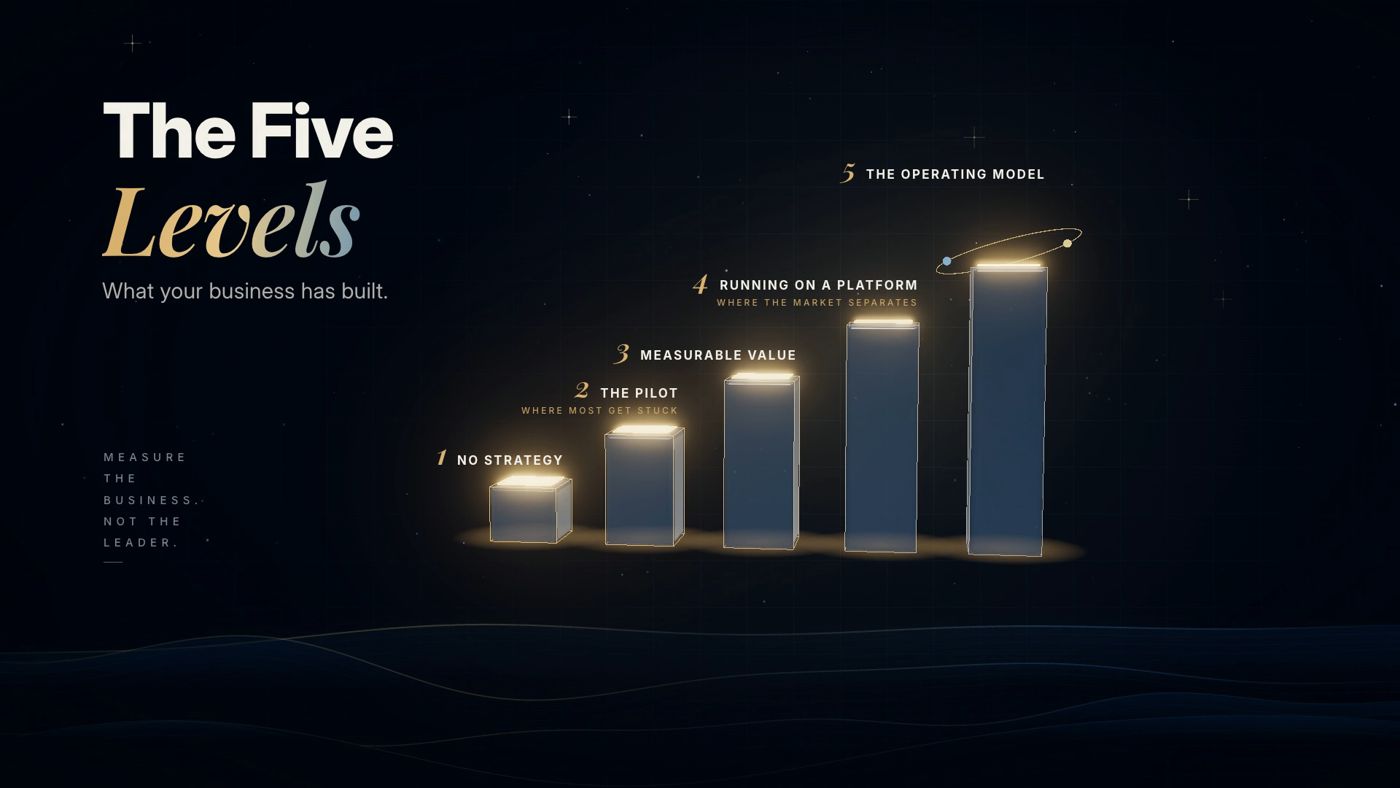
Carl measures AI maturity in five levels.
Level one. No strategy. Individuals have accounts. Somebody in marketing is using a chatbot. Nothing connects, and nothing compounds.
Level two. A pilot, a budget, an executive sponsor. This is where most mid-market manufacturers get stuck. Not because the pilots fail. Because they succeed, and nothing happens next.
Level three. A handful of use cases running and producing measurable value. Predictive maintenance. Demand forecasting. Quality inspection. A dedicated team, and real governance.
Level four. AI embedded across three or more core functions. The business is no longer running AI projects. It is running on an AI platform. This is where the market separates.
Level five. The line between AI projects and operations is gone. The intelligence layer is the operating model.
That is the map. And here is what most people miss about it.
The levels measure the business. What has been built. They do not measure the person who built it.
The level is the shadow. The question is who is casting it.
Because the level you're at is not a verdict on your leadership. The level you stay at is.
Three kinds of leader cast those shadows. One of them is almost certainly you. And the second one, the one that looks like the right answer, is the most expensive of the three.
The first is the Spectator.
The Spectator is watching. Not out of indifference. The Spectator cares a great deal. Reads the articles. Sits through the conferences. Hears the same pitch from five different vendors. And waits for the market to prove the move.
It is a sound instinct. Move too fast and you waste capital. Plenty of manufacturers have done exactly that.
But here is what the Spectator misses. The clock did not start when the Spectator decides the proof is in. It started when the serious leaders made their first moves. Every month since, their systems have been learning from their own plant floors.
There are no neutral positions in a compounding market. Waiting is a position. You did not pick it.
The Spectator pays what Carl calls the Catch-Up Penalty. In full, with interest, the moment they finally move.
The second is the Builder. And the Builder deserves respect, because the Builder is working harder than anyone in this conversation.
The Builder has the subscriptions. The pilots. The vendor relationships. A proof of concept in quality, another one in scheduling, a chatbot on the website. Money is going out. People are being hired. Things are happening.
The Builder is doing everything that looks like progress. And compounding the least.
Here is why. Every tool the Builder buys answers one question. What can we do with this? That is the second question. The first one is harder. What has to be true about our intelligence infrastructure before any of this compounds?
Without that answer, tools do not compound. They accumulate. The quality pilot does not know what the scheduling pilot learned. The scheduling pilot has never met the customer data. Each one works. None of them are talking to each other.
Picture a drawer full of subscriptions. Every one of them paid for. Every one of them doing its job. Drawers cannot learn.
Carl has a way of putting it. The Builder is building a perfect propeller. The Architect is building a jet engine.
And it gets worse at scale. A tool accelerates the system it sits in. If the system is broken, the tool breaks faster. The most expensive thing you can do is automate a mistake.
The Builder is not wrong to move. The Builder is moving before asking the question that decides whether any of it pays.
The third is the Architect.
The Architect does not have more tools than the Builder. Usually fewer.
The Architect made the one decision the Builder has not. Before buying the next thing, decide what the intelligence architecture looks like.
So the Architect knows where the plant's Digital Exhaust flows. Knows the three functions where intelligence moves margin the most. And has built the connections, so every deployment makes the next one smarter, and makes the previous ones better informed.
That is the one decision. It is not a technology decision. It is a leadership decision.
The Architect's advantage is not the AI. The AI is available to everyone. The advantage is the connected system every tool feeds, and the months of the plant's own data it has been learning from, while the Builder added subscriptions and the Spectator attended the conference.
You can subscribe to intelligence, or you can architect it. The subscription ends. The architecture compounds.
So which one are you?
Most leaders answer that too fast, and too kindly. And the honest answer usually lives in a handful of decisions nobody in the building has made yet.
That is what Carl built The Decision Room for. It takes leaders through the ten architectural decisions that come before any tool. Field. Chair. Sequence. Scoreboard. Governance. People. Not what to buy. What has to be decided first, and by whom.
It is five hundred dollars, and it includes a second seat, for the person you would tell at the kitchen table. These decisions are not made alone.
The first rung can be climbed for you. The last rung can only be climbed by you.
You will find it at carlpeterlin.com. The link is in the description.
Now, the part the Spectator and the Builder never see coming.
Here is the mechanism.
The leader who architects in month one is not six months ahead of the leader who starts in month seven. That is how it looks on a calendar. It is not how it works.
Every week that the first company's own operational data flows into a connected system, the next decision gets faster and more accurate. The first company makes every later decision from a data position the second company has not reached. By the time the second company starts, it is not catching up to where the first company was. It is chasing where the first company is going.
Intelligence compounds. It does not amortize.
That is why the gap is architectural, not a matter of time. And it is why Carl calls the destination the Unassailable Moat. You cannot close it from outside it.
Which leaves every manufacturer in one of two positions. There are two kinds of manufacturers in this market. One is paying the Catch-Up Penalty. The other is collecting it.
So here is the question. Not what level your business is at. Who is casting it.
If you are a Spectator: the signal you have been waiting for already came. The serious leaders moved. The window is still open.
If you are a Builder: the work is real, and so is the commitment. There is one question left, and it changes everything. Not what tools do you have. What does the architecture that makes them compound look like?
And if you are already asking that question, you have crossed the line. You are not a Builder who has not answered it. You are an Architect who has not started.
There is a question underneath all of this, and it is not about AI.
Somebody is going to make the architectural decision for your business. A vendor will make it by default. A competitor will make it for you, by moving first. Or you will make it on purpose.
Who better than you to lead this in your business?
Hold that question. Do not answer it yet.
If you want to answer it with your own numbers, in dollars, at your revenue, that is Carl's Strategic AI Intelligence Diagnostic. Carl works through it one on one with the CEO. That conversation starts with one email. [email protected]
Your business will have an AI architecture. The only question is whether leadership designs it, or inherits it.
The level you're at is not a verdict on your leadership.
The level you stay at is.
Carl J. Peterlin Jr. is a Strategic AI Intelligence Architect™ with 42 years of pattern recognition across four technology transitions. He works with the CEOs of $20M to $100M manufacturers on the strategy and the architecture that decide whether AI becomes a competitive advantage or an expense. Author of Death To Excel! and Your SMB AI Revenue Ratchet.